3D vs. Photos vs. Video: What Works Best in Real Estate Sales
In real estate sales, the first impression is formed even before a conversation with a sales agent – the moment a client sees visual content. Photos grab attention, videos set the mood, and 3D helps clients visualize the space and make a decision. But which format is truly the most effective? Let’s explore how different types of visualizations influence buyer behavior and why the right combination of formats is the key to successful sales.
In real estate marketing, visual content has long ceased to be just a “nice-to-have.” It is what shapes the first impression, holds the client’s attention, and often determines whether a user will reach out to the sales department. Photos, videos, and 3D visualizations are the three main tools developers use today. But do they all work the same way? And which format truly influences the decision to buy?
Photos: A Quick Start, but Limited Depth
Photography remains a fundamental tool in real estate sales. It’s easy to understand, loads quickly, and works well on listing portals and social media. Photos are effective when the property is already built or nearly complete, and the space doesn’t require a complex explanation.
However, photography has an obvious limitation – it captures only a single moment and a single angle. A client sees the interior or the facade but doesn’t always understand the layout, scale, or how the different areas relate to one another. For complex projects or properties still under construction, this is often insufficient.
Video: Emotion and Dynamics
Video adds movement and atmosphere. A camera’s sweep through a space, a lively atmosphere, and music – all of this helps evoke an emotional response. That’s why video works so well in digital advertising, on landing pages, and in presentations for investors.
However, video remains a linear format. The user watches a script that has already been created for them and cannot interact with the space. If a client wants to linger on a specific area, change the viewing angle, or return to the floor plan – video doesn’t allow for that. It captivates, but it doesn’t always explain.
3D Visualization: Understanding and Control
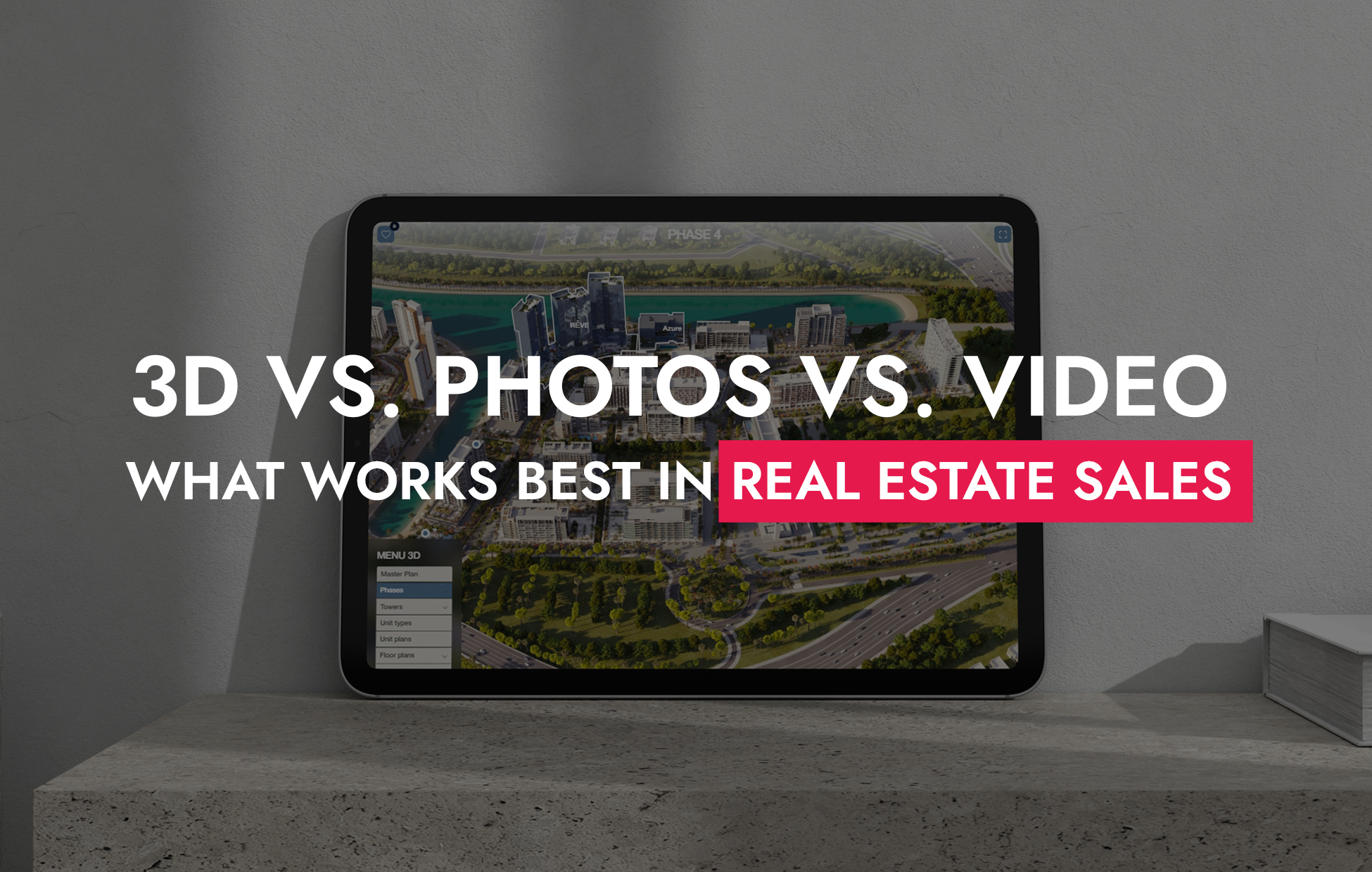
3D visualization and interactive formats offer something that photos and videos cannot – control on the part of the client. People don’t just watch; they explore the space: choosing viewpoints, moving between floors, comparing floor plan options, and evaluating the views from the windows.
3D plays a particularly important role in real estate sales during the early stages, when the property has not yet been built. This is where 3D becomes a tool for building trust: it helps the client visualize their future life in that space, rather than just taking our word for it.
In addition, 3D allows for content scalability. A single project can be adapted for a website, an interactive master plan, a VR tour, showroom presentations, or online meetings with clients.
Which one actually works better?
Experience shows that the question isn’t which format is “better,” but how they work together. Photos are great for grabbing attention, videos evoke emotion, and 3D helps with decision-making. It’s 3D that most often marks the stage where a client moves from initial interest to a specific inquiry.
For simple properties or the resale market, photos and a short video may be enough. But for new residential complexes, commercial spaces, and large-scale development projects, it’s difficult today to build an effective customer journey without 3D.
In modern real estate sales, visual content isn’t a choice between photos, videos, or 3D—it’s a strategy for combining them. Photos attract, videos inspire, and 3D explains and persuades. That’s why developers who invest in a comprehensive approach to visualization get not just more views, but higher-quality leads and faster decisions from clients.

Get in Touch
Drop us a line or give us a ring. We love to hear from you!