Residential vs. Commercial Interiors in 3D: What Is the Fundamental Difference in Approach?
Residential and commercial interiors may look equally impressive at first glance, but the approach to their 3D visualization is fundamentally different. In each case, it’s not just the style that changes, but also the logic of how the space is presented, the usage scenarios, the focal points, and even the goals the visualization is meant to achieve. In this article, we’ll explore how 3D visualization of residential and commercial interiors differs and why one-size-fits-all solutions don’t work here.
3D interior visualization has long ceased to be just a pretty picture. For developers, designers, and businesses, it’s a tool for communication, sales, and shaping expectations. However, an approach that works perfectly for residential spaces can be ineffective or even counterproductive for commercial properties. The reason lies in the different objectives, target audiences, and scenarios for using the space.
Different Objectives - Different Visualization Logic
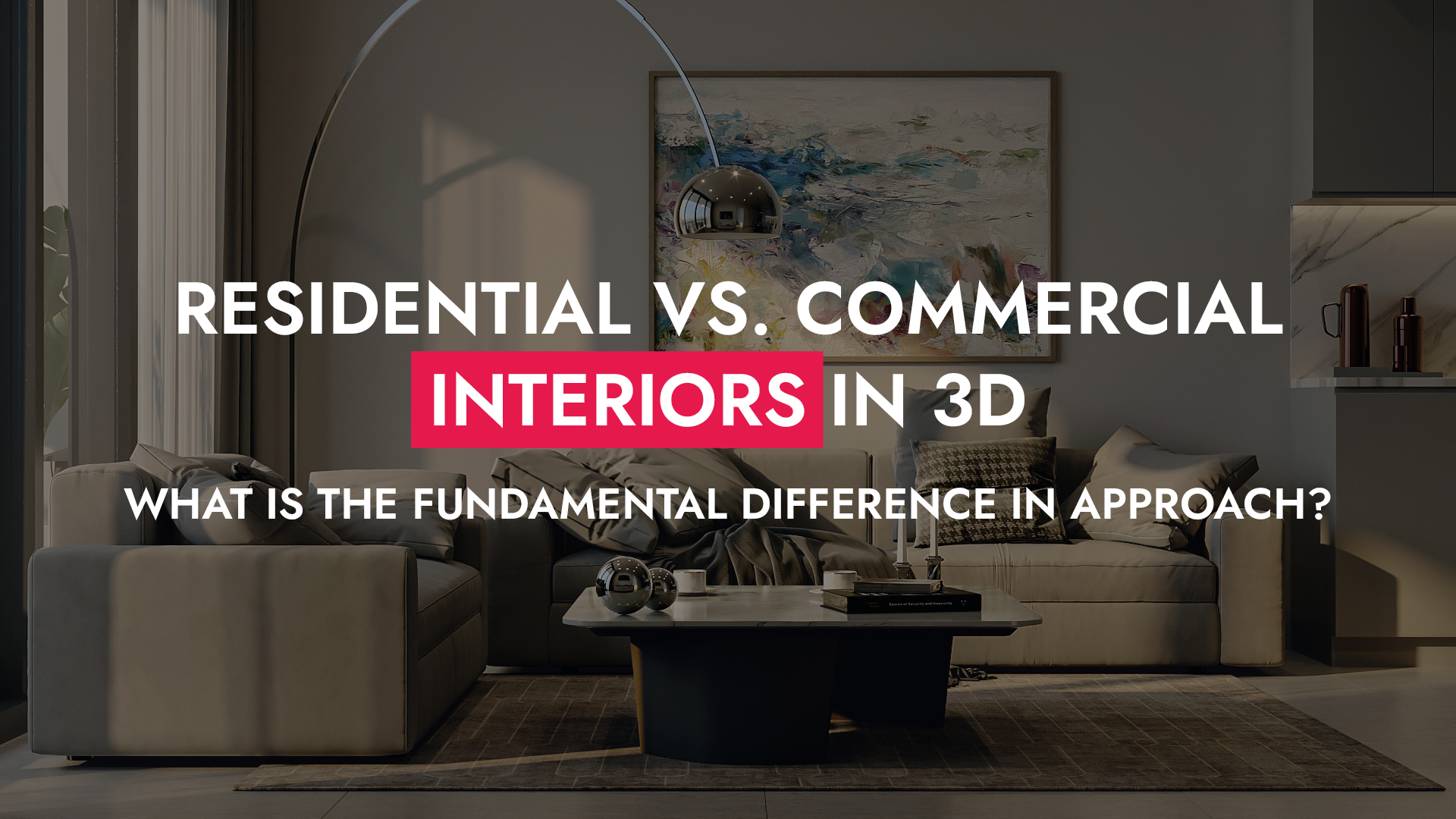
A residential interior in 3D always appeals to emotion. Its goal is to help people imagine themselves in the space, to feel comfort, coziness, and a certain lifestyle. In such renderings, the details of daily life are important: soft lighting, fabric textures, personal items, and lively accents. The space should “come alive,” even if it hasn’t been built yet.
Commercial interiors, on the other hand, are focused on function and business results. Here, 3D visualization should show how the space works: how visitors move, where key areas are located, and how staff or customer flow is organized. Emotion is also important, but it is secondary to the brand, usage scenarios, and efficiency.
The Audience Determines the Focus
In residential projects, the primary audience consists of future residents or buyers. They rarely analyze blueprints but respond well to atmosphere. Therefore, visualizations are often presented from a human eye level, in familiar everyday scenarios: morning light in the bedroom, an evening in the living room, a cozy kitchen with small details.
Commercial interiors have a broader and more diverse audience: investors, tenants, partners, and marketing teams. For them, the legibility of the space, scale, adaptability, and alignment with business objectives are key. Such renderings often use wider angles, emphasizing zoning and spatial logic rather than intimate details.
Light and Materials: Different Roles
In residential interiors, light serves as a tool for setting the mood. Soft shadows, warm tones, and natural lighting – all of these help create a sense of home. Materials appear tactile and “alive,” sometimes even with a slight imperfection that adds to their realism.
In commercial spaces, lighting often serves a navigational and presentational function. It highlights zones, pathways, products, or architectural elements. Materials should demonstrate durability, prestige, or brand alignment – not just aesthetics.
Space Usage Scenarios
In residential interiors, light serves as a tool for setting the mood. Soft shadows, warm tones, and natural lighting – all of these help create a sense of home. Materials appear tactile and “alive,” sometimes even with a slight imperfection that adds to their realism.
In commercial spaces, lighting often serves a navigational and presentational function. It highlights zones, pathways, products, or architectural elements. Materials should demonstrate durability, prestige, or brand alignment – not just aesthetics.
Residential 3D visualizations typically show one or more versatile lifestyle scenarios. The space is presented as a complete environment where everything is already “in its place.”
Commercial interiors often require flexibility. The same space can have multiple usage scenarios: different work formats, events, and foot traffic patterns. Therefore, in 3D, it’s important to showcase the space’s potential, not just a single final version.

Understanding the difference between residential and commercial interiors in 3D helps avoid common mistakes. When a commercial project is visualized as a residential one, it may look beautiful but fail to be compelling from a business perspective. Conversely, an overly “dry” approach to a residential space fails to evoke an emotional connection.
Professional 3D visualization always begins with the question “for whom and for what purpose.” It is the answer to this question that determines the style, presentation, and effectiveness of the final result.
Residential and commercial interiors in 3D aren’t two different styles, but two different approaches to communication. One sells a dream and a sense of home; the other sells an idea, a function, and business potential. When these differences are taken into account, 3D visualization ceases to be merely an image and begins to function as a strategic tool.
Get in Touch
Drop us a line or give us a ring. We love to hear from you!